You send your 13-digit CNIC to 8171 and stare at the screen. Seconds feel like minutes. You refresh the portal, retype the captcha, and try again.
Every quarter, this uncertainty hits millions of Pakistani families who depend on the Benazir Income Support Programme to put food on the table, pay utility bills, and cover school expenses.
The moment you know your status from eligible, payment released, to still under verification, it changes your next move entirely. Getting that answer now takes less than a minute, and you do not need an internet connection, an agent, or a single rupee.
What 8171 Check Online Actually Is And What It Is Not?
The number 8171 is not a magic code or a shortcut. It is a dedicated government SMS shortcode and web portal operated under the Benazir Income Support Programme, tied directly to the National Database and Registration Authority.
When you enter your CNIC, the system performs three things in rapid succession:
- It cross-references your identity with NADRA records to confirm the CNIC is valid, active, and belongs to a real person.
- It pulls your household data from the National Socio-Economic Registry, the massive survey database that determines poverty scores and eligibility.
- It returns your real-time status from eligible, payment issued, under verification, record not found, to not eligible, based on the latest payment cycle and survey results.
This is the same database that BISP Tehsil offices, HBL Konnect agents, and payment camp operators use. There is no separate system for insiders. If your data is correct in NSER, your status will show correctly here.
If it is outdated or missing, the portal will tell you that too.
The 2026 update has tightened integration with NADRA. This means fewer “verification pending” errors, faster captcha loading, and a mobile-friendly design that works even on older smartphones and slow connections.
The system now refreshes eligibility data after every dynamic survey update, so changes you make at a BISP office can reflect online within 3 to 7 working days.
The Two Ways to Check
There are only two official methods. Anyone offering a third method such as a paid app, a WhatsApp service, or a “special agent portal” is running a scam. Don’t get into that trap.
Method 1: 8171 SMS Check (Works Without Internet)
This is the method used most in rural Punjab, interior Sindh, Balochistan, and Khyber Pakhtunkhwa, and anywhere the internet is unreliable or unavailable.
- Open your phone’s messaging app.
- Type your 13-digit CNIC number — no dashes, no spaces. For example:
4210112345678. - Send the message to 8171.
- Wait for the automated reply. It usually arrives within 30 to 60 seconds.
The reply message contains one of the following: Eligible, Not Eligible, Under Verification, Payment Issued, or Record Not Found.
Each message points to a specific next action.
Eligible means wait for the payment collection SMS.
- Payment Issued means you can visit a payment center.
- Under Verification means your data is being reviewed and you should wait a few days and check again.
- Standard SMS charges may apply depending on your mobile network, though the service itself is free.
You must use a SIM card registered under your own CNIC. Sending from an unregistered SIM often produces no reply or an error.
Method 2: 8171 Web Portal Check (Shows Detailed Status)
If you have access to a browser or you are on a smartphone, a laptop, or even a shared computer, the web portal gives you more information than SMS.
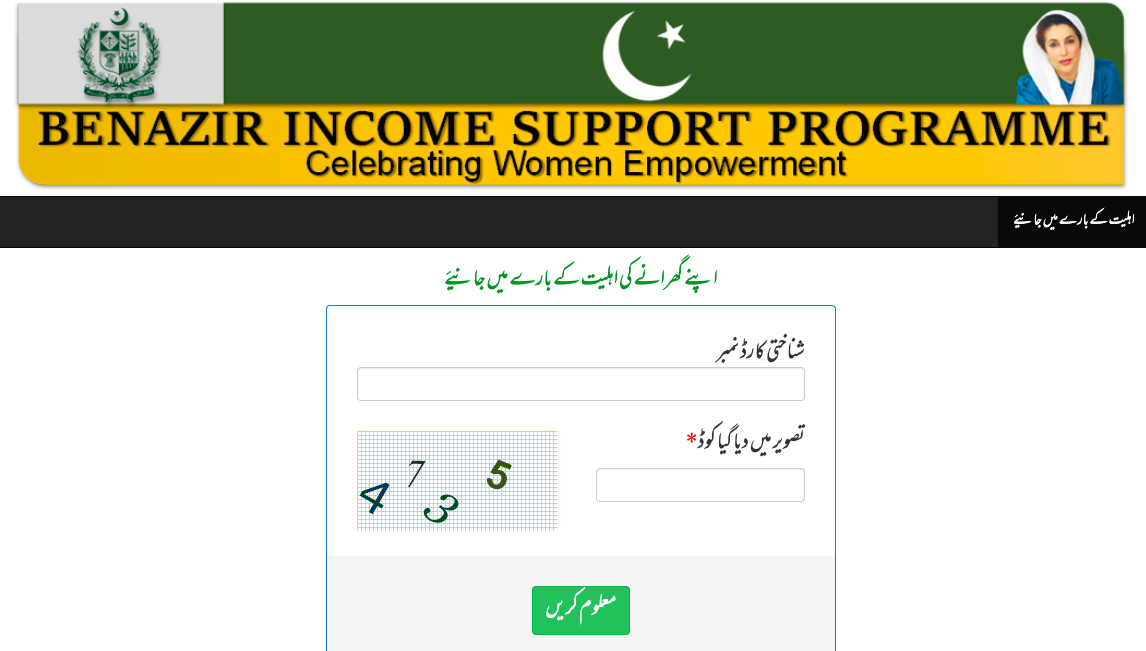
- Open your browser and go to the official portal: 8171.bisp.gov.pk (or www.bisp.gov.pk).
- Enter your 13-digit CNIC without dashes.
- Complete the captcha code shown on screen. This is a 4-digit security code that prevents automated bots from abusing the system.
- Click the Submit or Check Status button.
Within seconds, the screen displays your full eligibility status, payment details if any have been released, your registered name as per NADRA, and sometimes the next expected payment date.
The portal also shows “Payment History” for beneficiaries who have received previous installments. This is useful for tracking missed payments or confirming that older amounts were correctly credited.
A Note on Fake Portals
Scammers create websites that look almost identical to the real 8171 portal.
They collect CNIC numbers, sell data, or charge fees for “fast-track approval.” Only two domains are official: 8171.bisp.gov.pk and bisp.gov.pk. Anything ending in .com, .org, .pk with extra words, or requesting payment is fraudulent.
Bookmark the real address and never search for it through random Google links each time.
Status Messages and What They Actually Mean
The reply you get is not always self-explanatory. Here is a plain-language breakdown of every possible status and exactly what you should do next.
| Status Message | What It Means | What You Should Do |
|---|---|---|
| Eligible | Your household meets BISP criteria and your CNIC is verified. | Wait for the official payment release SMS. It will tell you when and where to collect. |
| Payment Issued / Released | The current installment has been credited and is ready for collection. | Visit your nearest payment camp, HBL Konnect agent, or partner bank ATM. Bring your original CNIC for biometric verification. |
| Under Verification | Your data is being reviewed — either because of a recent NSER survey update, biometric mismatch, or NADRA cross-check. | Wait 3–7 working days and check again. If the status does not change, visit your nearest BISP Tehsil Office. |
| Record Not Found | No NSER survey data is linked to this CNIC, or the survey is outdated. | Complete or update the NSER Dynamic Survey at the nearest BISP center. Without survey data, no payment will be issued. |
| Not Eligible | Your household does not meet the current poverty score threshold, or you are flagged as a government employee, taxpayer, or property owner. | Visit the BISP office to request a re-evaluation if your circumstances have changed. |
Many families panic when they see “Record Not Found” or “Not Eligible.” These are not permanent rejections.
An expired CNIC, a change in marital status not updated with NADRA, or an incomplete NSER survey can all trigger these messages.
Fixing the underlying record almost always resolves the status within a couple of weeks.
How to Fix Common Problems?
CNIC Not Found or No Record
This usually means your household has not completed the NSER Dynamic Survey. Visit the nearest BISP Tehsil Office with your original CNIC, your children’s B-Forms (if applicable), and a recent utility bill as proof of residence. Request the survey update. Once completed, your data enters the system and the 8171 check should start returning results within a few days.
Verification Pending for Weeks
If “Verification Pending” persists beyond 7 working days, the issue is likely a biometric mismatch between your fingerprints at NADRA and what BISP has on file. Visit a NADRA office first, and re-register your biometrics if your fingerprints have faded or changed. Then take your updated NADRA verification to the BISP office and request a manual re-verification. This two-step fix resolves most long-pending cases.
SMS Sent but No Reply Received
Network congestion during payment release days can delay replies. Wait 30 minutes and resend. If you still receive nothing, your mobile SIM may not be registered under your own CNIC; the system filters out unregistered numbers. Try the web portal instead, or visit a BISP office for in-person verification. The SMS method should work on Jazz, Telenor, Zong, and Ufone without any special activation.
Payment Issued but Fingerprints Fail at Collection Point
This is frustrating but fixable. Try a different payment center; sometimes, a particular biometric machine has calibration issues. If fingerprints fail at multiple locations, visit NADRA for biometric re-registration. Some centers now offer facial recognition as an alternative verification method, reflecting the 2026 NADRA upgrades rolled out earlier this year.
Expired CNIC
An expired CNIC automatically blocks eligibility even if you were previously receiving payments. Renew it at any NADRA office. Once renewed, send your CNIC to 8171 again. The system updates your status after the next NADRA-BISP data sync.
Checking by District and Region
In 2026, BISP releases payments district-wise in phases to prevent overcrowding at payment centers. The 8171 portal now includes a district selector in some regions. After entering your CNIC and captcha, you may be prompted to choose your district from a dropdown list. The system then shows not only your eligibility but also the expected payment release date for your specific district and the nearest assigned payment center.
Rural beneficiaries in remote areas of Balochistan, Tharparkar, and merged tribal districts often rely on the SMS method exclusively. For them, the district-wise schedule comes through a follow-up SMS a few days before the payment camp opens. If you live in a hard-to-reach area, save the SMS confirmation and plan your visit only after receiving it. Going before the scheduled date means a wasted trip.
Payment Amounts in 2026
The quarterly installment under BISP Kafaalat remains Rs. 13,500 per eligible family throughout 2026. This is paid every three months, January, April, July, October.
Some beneficiaries see higher amounts and assume there has been a permanent increase. Here is what is actually happening:
- Rs. 14,500 — This appears under specific phases of the Ehsaas program, not the standard Kafaalat. It may include one-time adjustments or phase-specific allocations.
- Rs. 19,500 — This is not a fixed payment. It combines a current installment with a previously unpaid installment. If you missed a previous quarter, the system may release both together, creating a higher one-time amount.
- Rs. 25,000 — Similarly, this reflects accumulation, two standard installments plus possible Taleemi Wazaif (education stipends for children). It is not a permanent entitlement.
- Rs. 27,000 — Double payment for beneficiaries who were eligible but missed two consecutive cycles. Released as a catch-up, not a recurring amount.
The 8171 portal and SMS reply show your exact amount. Do not rely on word-of-mouth from neighbors or social media posts claiming blanket increases. Every CNIC returns an individualized status.
Comparison — The Three Verification Channels
| Method | Requirements | Speed | Best For |
|---|---|---|---|
| 8171 SMS | Any mobile phone; SIM registered under your CNIC | 30–60 seconds | Rural users without internet; quick status check |
| 8171 Web Portal | Smartphone or computer with internet; CNIC; captcha | Instant | Detailed status, payment history, registration |
| BISP Tehsil Office | Physical visit; original CNIC; supporting documents | 1–2 business days | New registration, NSER survey update, biometric issues |
The SMS method covers about 80% of use cases. The web portal is necessary when you need payment history or want to register for the first time. The physical office is a last resort for unresolved data problems, not a first stop for routine status checks.
When NOT to Use the 8171 Check?
The 8171 system is powerful but not universal. Here are the scenarios where it will not work, cannot help, or should not be your first move.
- You have never completed an NSER survey. Sending your CNIC to 8171 without survey data will always return “Record Not Found.” The first step is visiting a BISP office and registering through the Dynamic Survey — not checking 8171 repeatedly.
- Your CNIC has expired. The system validates against active NADRA records. An expired CNIC blocks everything. Renew first, check later.
- You are a government employee, taxpayer, or large asset holder. Even if you feel you deserve support, the system automatically filters out these categories based on NADRA and FBR data. No amount of checking will change that classification.
- You are checking on behalf of someone else using your own SIM. The SMS method requires the SIM to be registered under the same CNIC being checked. Using a friend’s phone often produces no reply or a mismatch error, even if the beneficiary is eligible.
- You are looking for the Ehsaas Emergency Cash Program (2020–2022). That specific COVID-era program ended years ago. The 8171 portal covers ongoing BISP and current Ehsaas phases — not closed historical programs.
- You want to register from abroad. BISP eligibility requires physical presence in Pakistan and household verification through local surveys. An overseas Pakistani cannot register remotely. Family members in Pakistan must complete the in-person process.
- You received an SMS or WhatsApp message claiming you are “pre-approved” and asking for a fee. This is a scam. 8171 never asks for money, OTP codes, or personal details via WhatsApp. Delete the message. Do not engage.
8171 Fraud Awareness
The 8171 ecosystem has attracted fraudsters who prey on desperation. Their methods evolve, but the red flags remain consistent:
- Anyone asking for payment to “approve” or “fast-track” your BISP status is a criminal. The entire process — registration, verification, payment collection — is completely free.
- Any phone call claiming to be from BISP asking for your CNIC, OTP, or bank details is a scam. BISP communicates through SMS from 8171 only — never through personal calls or WhatsApp.
- Any website other than
8171.bisp.gov.pkorwww.bisp.gov.pkasking for your CNIC is suspicious. Scammers clone the portal design. Check the URL character by character. - Any agent offering to “add your name to the list” for a commission is exploiting you. Eligibility is determined by NSER survey data and NADRA verification — no individual can override the database.
If you encounter fraud, report it to the BISP helpline at 0800-26477 or visit the nearest Tehsil office to file a complaint.
The Digital Wallet Shift
The most significant operational change in 2026 is the phased rollout of the BISP Digital Wallet System. Instead of collecting cash from payment camps or HBL Konnect agents, beneficiaries can now receive their Rs. 13,500 directly into a mobile wallet such as JazzCash, Easypaisa, or a dedicated BISP-linked account.
The registration process for digital wallets is separate from the 8171 eligibility check. You first confirm eligibility via 8171, then visit a designated center to link your CNIC and biometrics to a wallet account. The government is distributing free SIMs to beneficiaries in selected districts to accelerate adoption. Once activated, payments arrive without any need to travel, queue, or interact with intermediaries.
This does not replace the 8171 check at all, but it builds on it. You still check your status via 8171. The difference is that “Payment Issued” now means funds credited to your phone, not cash waiting at a camp.
Terms Glossary
To help you not get confused, here’s a glossary of common terms so you understand everything easily:
- BISP (Benazir Income Support Programme): Pakistan’s flagship unconditional cash transfer program, launched in 2008, providing quarterly stipends to low-income women across the country.
- Ehsaas Program: A broader poverty alleviation framework launched in 2019, encompassing multiple initiatives including cash transfers, education stipends, and health support. The 8171 system serves both BISP and Ehsaas.
- CNIC (Computerized National Identity Card): The 13-digit unique identification number issued by NADRA to every adult Pakistani citizen. It is the primary key for all government welfare databases.
- NADRA (National Database and Registration Authority): The government agency responsible for maintaining the national citizen database, issuing CNICs, and providing biometric verification services.
- NSER (National Socio-Economic Registry): A household-level survey database that collects information on income, assets, family size, employment, and living conditions. BISP eligibility depends entirely on NSER data.
- Dynamic Survey: The ongoing, updatable version of NSER. Beneficiaries can request survey updates at BISP Tehsil offices when their household circumstances change.
- BISP Kafaalat: The core cash transfer component of BISP, providing quarterly installments to female heads of eligible households.
- Taleemi Wazaif: Education stipends under Ehsaas, paid to children of BISP beneficiaries who maintain at least 70% school attendance. These amounts appear as additions to the standard Kafaalat installment.
- PMT Score (Proxy Means Test): A statistical poverty score calculated from NSER data. Households below a threshold score (typically 32 or lower) qualify for BISP. The exact threshold is periodically revised.
- HBL Konnect: A branchless banking service by Habib Bank Limited, authorized to disburse BISP payments across Pakistan through biometric verification at agent locations.
- Biometric Verification: The process of confirming identity through fingerprint or thumbprint matching against NADRA records. Mandatory before any payment can be collected.
- BISP Tehsil Office: The local administrative center where beneficiaries register, update surveys, resolve disputes, and file complaints. Each district has multiple Tehsil offices.
You do not need anyone’s permission to find out where you stand. The 8171 number does not judge, delay, or demand. It reflects what the government database already knows about your household, nothing more, nothing less. The power is in checking early, before payment dates, before rumors spread, before anxiety builds.
A 30-second SMS or a one-minute portal visit tells you whether your payment is ready, your data needs updating, or your eligibility is intact. That clarity lets you act, visit the camp with confidence, update your NSER survey without panic, or ignore the fraudster’s WhatsApp message because you already know the truth from the source.
Type your CNIC. Send it to 8171. Know your status.
The system works for millions of Pakistani families every single day.
In 2026, it works faster and more transparently than ever before. Use it.